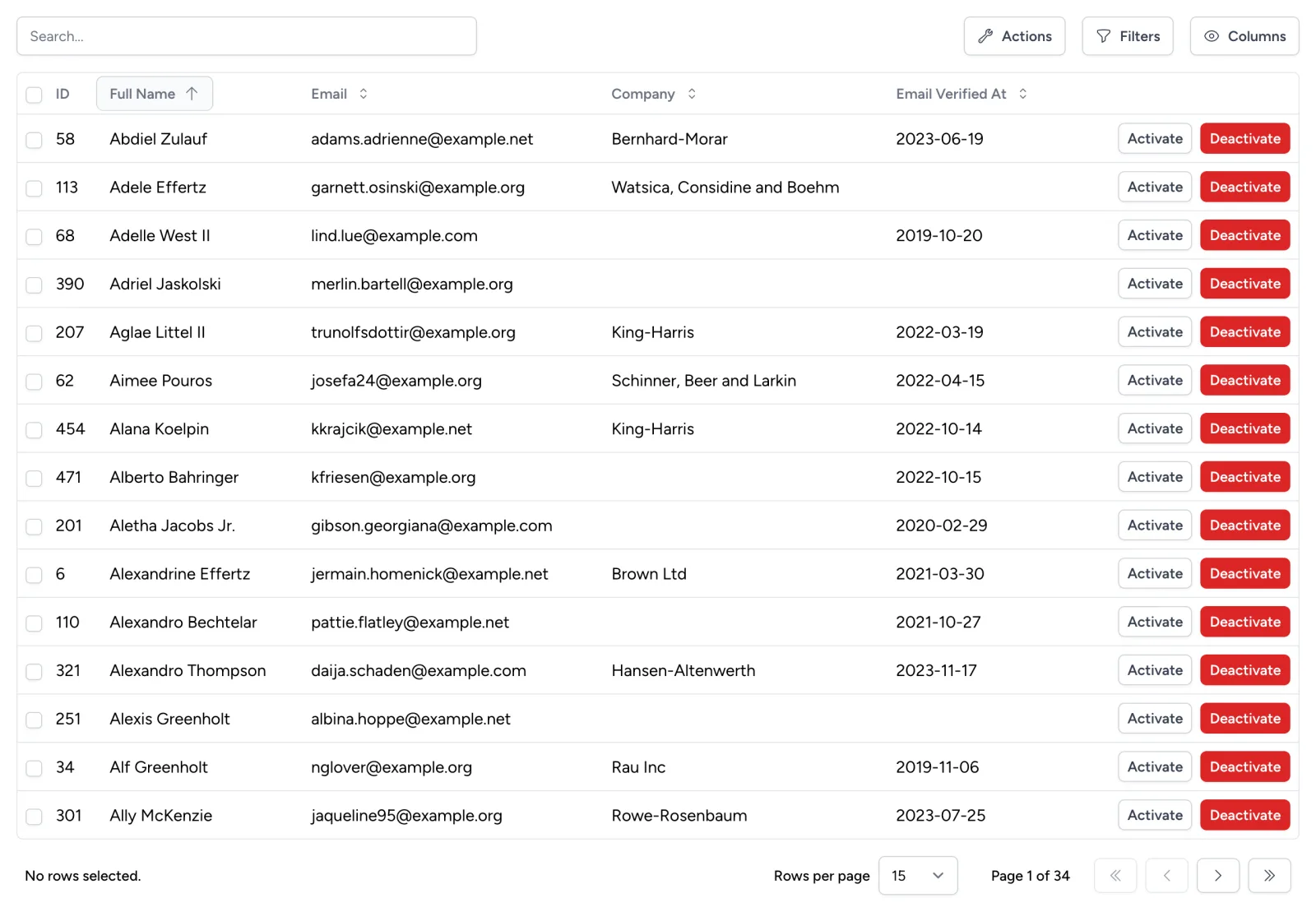
Inertia Table
The table you would build, built.
One query builder drives sorting, filters, exports, saved views, and bulk actions, defined once in PHP. Render the same polished table in Vue 3 or React 19.
Explore Inertia Table €199 · single project
Inertia UI · Laravel-first components
Define the difficult parts in Laravel. Ship polished tables and forms in Vue 3 or React 19 without maintaining the same interface twice.
 Built by
Inertia Table
One query builder drives sorting, filters, exports, saved views, and bulk actions, defined once in PHP. Render the same polished table in Vue 3 or React 19.
A real form rendered from a PHP class. The controls are live.
Inertia Forms
Over 30 field types, validation, uploads, model binding, and multi-step flows stay together in PHP, with native Vue 3 and React 19 renderers included.
Laravel Boost + AI coding
Laravel Boost gives agents your Laravel context. Inertia UI gives them proven table, form, and modal contracts, so a prompt starts from production behavior instead of a blank component plan.
Shared JavaScript core
Inertia UI Vanilla is the lightweight, pure JavaScript foundation behind Inertia Forms, Modal, and Table. The Vue and React packages all use it for the interaction behavior they share.
First-party primitives. No wrappers.
Every shared interaction is written and maintained here. That is what keeps Vue and React behaving the same way: a fix in one place lands everywhere at once.
It also means less adapter code, fewer workarounds around someone else's assumptions, and direct control over behavior on the day it needs to change.